
When people see a prediction like Home Win (1) or Over 2.5 Goals, it may look simple. But behind that prediction, there is a full process that uses a lot of data and logic.
In 2026, football predictions are not based on guessing. They are built using numbers, patterns, and careful analysis.
Let’s take a look behind the scenes and see how it really works.
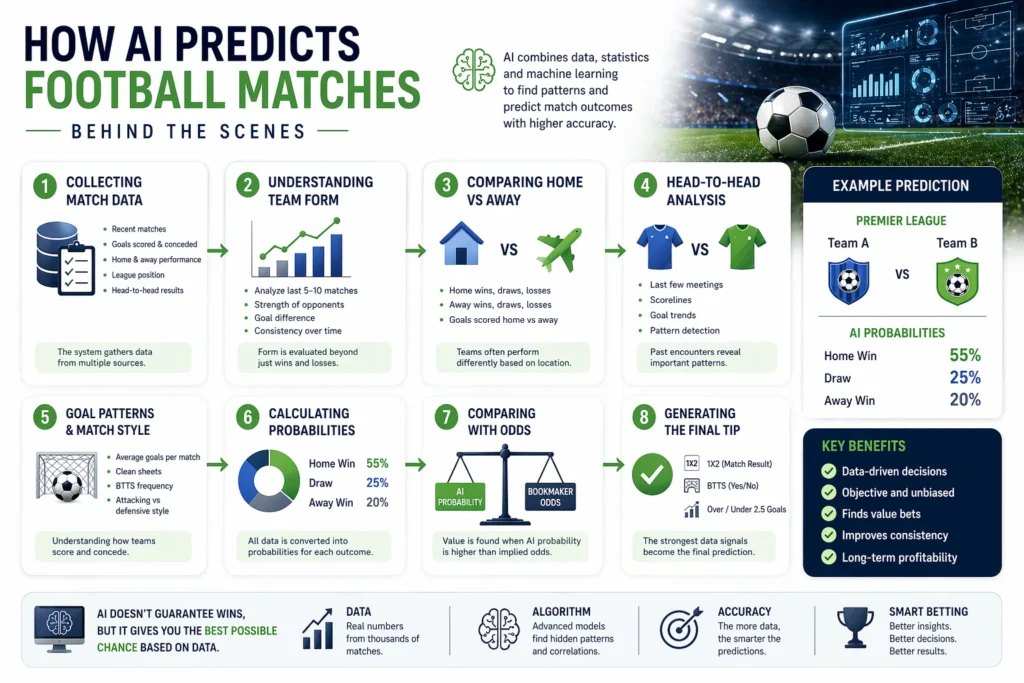
Step 1: Collecting Match Data
Everything starts with data.
Before making any prediction, the system gathers information about both teams. This includes:
- Recent matches (last 5–10 games)
- Goals scored and conceded
- Home and away performance
- League position and points
- Head-to-head results
For example:
- Team A scored 10 goals in last 5 matches
- Team B conceded 8 goals in last 5 matches
This already gives an idea of how the match might look.
Step 2: Understanding Team Form
Form is one of the most important factors.
Instead of just looking at wins and losses, the system checks:
- How strong the opponents were
- Goal difference
- Consistency over time
For example:
- A team that wins against weak opponents is not the same as a team that performs well against strong teams
This helps build a clearer picture of real strength.
Step 3: Comparing Home vs Away Performance
Teams often play very differently depending on location.
Some teams are strong at home but weak away. Others are more balanced.
So the system checks:
- Home wins, draws, losses
- Away performance
- Goals scored at home vs away
Example:
- Team A wins 70% of home matches
- Team B loses 60% of away matches
This increases the chance of a home win.
Step 4: Head-to-Head Analysis
Past matches between the same teams can reveal patterns.
The system looks at:
- Last few meetings
- Scorelines
- Goal trends
For example:
- If 4 out of last 5 matches had over 2.5 goals, there is a higher chance it happens again
But this is not used alone — it is combined with other data.
Step 5: Goal Patterns and Match Style
Not all teams play the same way.
Some teams:
- Score a lot but also concede
- Play defensive and keep low scores
- Start strong or finish strong
The system checks:
- Average goals per match
- Clean sheets
- Both Teams To Score (BTTS) frequency
This helps predict:
- Over/Under 2.5
- BTTS Yes/No
Step 6: Calculating Probabilities
After collecting all the data, the system converts it into probabilities.
For example:
- Home win: 55%
- Draw: 25%
- Away win: 20%
This is where everything comes together.
Instead of guessing, each outcome gets a clear percentage based on data.
Step 7: Comparing With Odds
Predictions alone are not enough.
The system also checks bookmaker odds and compares them with calculated probabilities.
This helps find:
- Good betting opportunities
- Matches with value
For example:
- If a team has 60% chance but odds suggest only 50%, that is important
Step 8: Generating the Final Tip
After all the steps, the system gives a final prediction.
This can be:
- 1X2 (match result)
- BTTS (Yes/No)
- Over/Under 2.5 goals
Each tip is based on the strongest data signals.
Why This Process Works
This method is effective because:
- It uses multiple data points
- It avoids emotional decisions
- It stays consistent across all matches
A human might miss details or focus on only one factor. A data-driven system looks at everything together.
What It Does NOT Do
It is important to understand what this system does not do.
- It does not guarantee wins
- It does not predict exact scores every time
- It does not rely on luck
Football is unpredictable, and surprises always happen.
But using structured data gives a better chance over time.
Simple Example
Let’s say:
- Team A is strong at home
- Team B struggles away
- Both teams score often
The system might predict:
- Home win (1)
- Over 2.5 goals
- BTTS Yes
This is not random. It is based on patterns seen in data.
Final Thoughts
Behind every good prediction, there is a clear process.
In 2026, successful betting is not about guessing. It is about understanding how matches are analyzed.
If you know what goes into a prediction, you can trust it more and use it better.
Focus on the data. Look at probabilities. Stay consistent.
That is how modern football predictions are built.